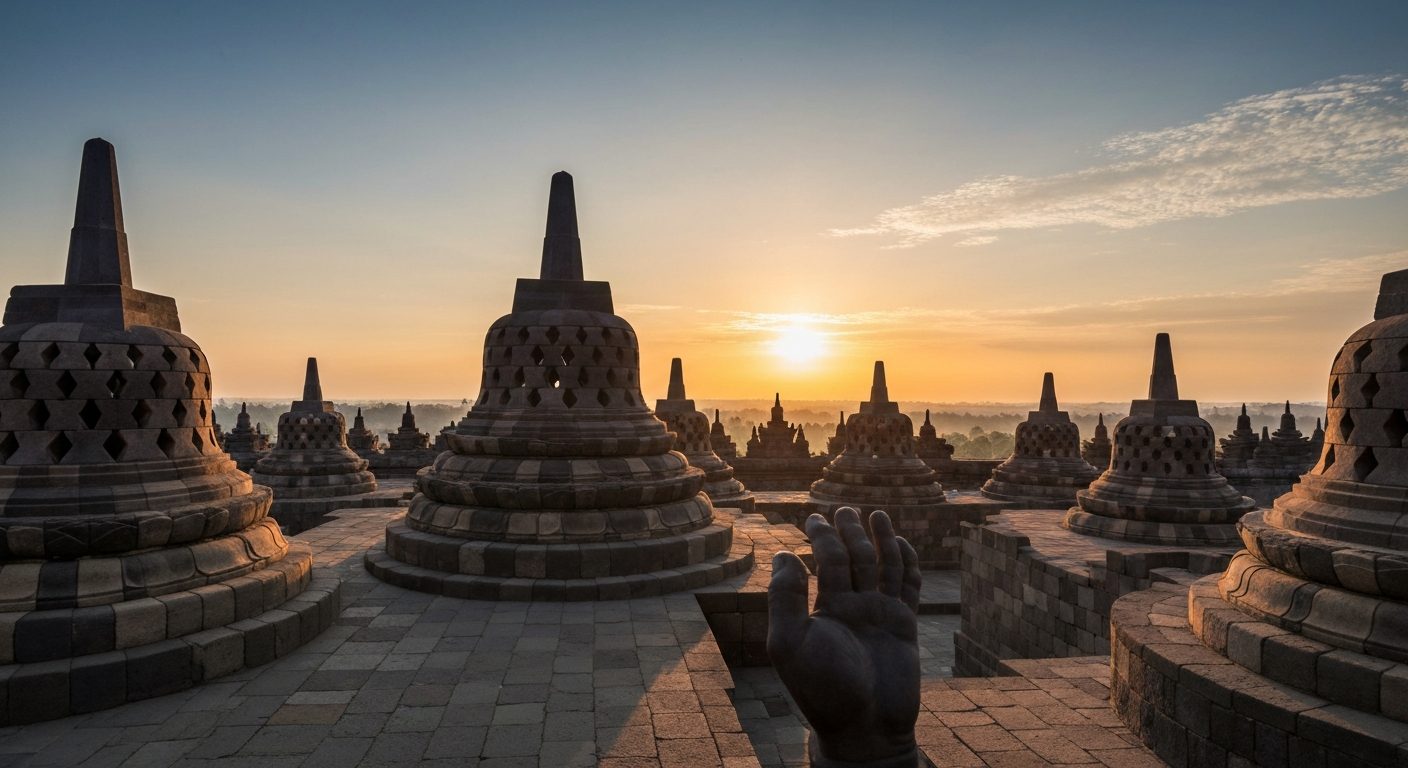
Borobudur temple best time sunrise visit planning usually means two things: choosing the right month for clear skies, and the right time slot to avoid the worst crowds. For most travelers, that sweet spot is a dry-season morning, entering on one of the first timed slots just after the formal “sunrise” period.
As Java From Bali’s volcano and trekking researcher, I spend a lot of time shuttling guests between Ijen, Bromo, Yogyakarta and back to Bali. Borobudur and Prambanan are the cultural anchor of that circuit. This guide is the briefing I wish every Bali-based visitor read before they book.
I’ll cover how sunrise at Borobudur actually works now (no more free-roaming at dawn), how the new ticket and quota system feels on the ground, Borobudur dress code requirements and what to wear, Prambanan temple opening hours and dress code, and how to fit both temples into a one-day plan from Yogyakarta or as part of a Bali-to-Java route.
All logistics and ranges below are based on field checks and official sources last verified June 2026. Details like prices and time slots do change, so always re-check close to your travel date.
—
Quick facts: Borobudur & Prambanan at a glance
- Location
- Borobudur ~40 km northwest of Yogyakarta; Prambanan ~17 km east of Yogyakarta.
- Typical drive times
- Yogyakarta–Borobudur: 60–90 minutes; Yogyakarta–Prambanan: 40–60 minutes (longer in peak traffic).
- Usual visiting window
- Gates open from early morning to late afternoon; evening cultural shows at Prambanan on select days.
- Structures
- Borobudur: 9 levels, ~72 iconic stupas on the top terraces. Prambanan: main Shiva temple ~47 m tall.
- Indicative entrance fees (foreign visitors)
- Combined Borobudur–Prambanan tickets typically fall in the US$40–60 range per adult, depending on package and access level, last verified June 2026.
- Best month to visit Borobudur (weather)
- Generally June–August for lower rainfall and more stable mornings; shoulder months April–May and September–October can be good with fewer crowds.
- Dress code
- Modest clothing required at both sites: shoulders and knees covered; sarongs often provided.
- Same-day visit?
- Yes, Borobudur + Prambanan in one day is very possible with private transport and an early start.
—
Best time to visit Borobudur: season, time of day, crowds
Best month to visit Borobudur for weather
Central Java is tropical. You’ll never find “cold and crisp” like in the Alps, but you can choose between wetter and drier periods.
- Drier months (roughly June–August)
- Lower rainfall, more stable sunshine.
- Cooler mornings; midday sun is strong but humidity a bit more tolerable.
- This is also peak domestic and international travel, so expect more people and higher accommodation demand.
- Shoulder months (April–May, September–October)
- Our favorite compromise.
- Rain tends to fall as short showers rather than all-day storms.
- Crowds slightly lighter than July–August and big holiday periods.
- Rainier months (roughly November–March)
- Cloudier mornings, higher chance of rain during the day.
- Landscapes are greener and photos can be beautiful with mist and cloud layers.
- Better availability and sometimes lower hotel rates.
Java’s weather is never guaranteed. I’ve had crystal-clear sunrises in January and grey skies in August. Use “best month to visit Borobudur weather” as a guideline, not a promise.
Best time of day: sunrise versus later morning
Borobudur used to allow very early pre-dawn access onto the upper levels, with big tripod setups and tour buses rolling in at 4:00 am. That era is gone.
Today, you’ll likely have two main options:
- Early entry (around sunrise)
- Limited, timed-entry “sunrise” or first-morning slots that get you onto the monument near or just after dawn.
- Best for softer light, cooler temperatures, and a calmer atmosphere.
- Requires pre-booking as quotas are limited.
- Regular morning entry
- From after sunrise through late morning.
- Still good light until about 9:00–9:30 am. After that, sun is high and harsh for photography.
- Warmer and busier, but easier to arrange if you don’t want a very early wake-up.
My on-the-ground recommendation:
- Aim to enter the complex as early as your ticket allows, even if you can’t get the official “sunrise” quota.
- Try to be on the upper terraces by 7:00–8:00 am for the best balance of light and temperature.
- Avoid midday to mid-afternoon if you are sensitive to heat; the stone radiates warmth and shade is limited.
—
How Borobudur sunrise tickets and timed-entry slots work (now)
Rules change more often here than on a typical hiking route, but the basic structure in 2025–2026 looks like this:
1. Two layers of access: temple yard vs. monument structure
There is a critical distinction:
- Temple park / courtyard access
- Lets you enter the larger Borobudur park area, walk around, visit the museum, and see the temple from below.
- Capacity is relatively high and standard tickets are usually available on the day, except on major holidays or special closures.
- Monument structure access
- Allows you to climb the stone stairways and walk the terraces and stupas.
- Strict daily quotas to protect the stonework. You’ll receive a specific time slot and often simple footwear covers.
- Sometimes sold as an add-on or as a different category of ticket.
If you care about the carvings and the classic stupa walk, you need the structure access. If you just want to see Borobudur from the outside and take photos from the lawns, the yard ticket is enough.
2. Borobudur sunrise ticket booking and advance slots
For the earliest morning slots, the reality on the ground is:
- Quotas are limited.
This isn’t marketing; it’s a conservation rule. Tickets that let you onto the structure early are often capped at a few hundred people per day, sometimes less, spread across time slots.
- Advance booking is strongly recommended.
You can usually book:
- Via official online platforms run by the managing authority.
- Via Yogyakarta hotels / local agents.
- Through a multi-day Java from Bali itinerary with us, where our reservations team coordinates permits and transfers via licensed Yogyakarta operators.
- Slots are typically time-banded.
For example, you might choose among early morning, mid-morning, early afternoon. Each band defines when you can go up; you can still be in the park outside that window.
- ID requirements.
Expect to show your passport or a copy for foreign-visitor tickets. This also helps verify that the name on the booking matches the person entering.
Always check the current rules on an official Borobudur site or with a trusted operator, because the exact “sunrise” branding, times and rules for monument access have been adjusted several times since 2022.
3. How it feels in practice
Here’s what it’s like as a visitor with an early slot:
- You arrive at the main gate 30–60 minutes before your allocated entry band.
- You show your booking and ID, pass a simple security check, and walk or ride an internal shuttle closer to the temple.
- Before climbing, staff may:
- Explain conservation rules.
- Ask you to wear shoe covers or remove shoes in some sections.
- Remind you not to climb on stupas or touch reliefs excessively.
- Once your time window opens, you’re allowed up via marked stairways.
- You’ll share the terraces with other visitors, but early slots feel quieter and more contemplative than mid-morning waves.
If you miss your slot, staff may refuse monument access, so do not cut arrival times too fine.
—
Borobudur dress code requirements: what to wear
Borobudur is both a UNESCO World Heritage Site and a Buddhist monument. The Borobudur temple modest clothing requirements are taken seriously at the gate, especially for foreign visitors.
Core principles of the dress code
- Cover shoulders and upper arms.
No strapless tops, low-cut tank tops, or sports bras as outerwear. Short sleeves are generally fine.
- Cover knees.
Shorts and skirts should go at least to the knee. Very tight or see-through clothing is discouraged.
- Respectful overall appearance.
Clothing with offensive slogans or graphics may be refused. Beachwear is not appropriate.
In practice, many visitors arrive in casual travel outfits and use a provided sarong or additional wrap if needed.
Borobudur dress code requirements: what to wear in real life
Here’s what works well in Java’s heat while staying respectful:
- Tops
- Lightweight cotton or linen T-shirts.
- Loose long-sleeve shirts for sun protection.
- Avoid strappy camisoles as your only layer; bring a light cover-up.
- Bottoms
- Airy trousers or travel pants.
- Midi or maxi skirts / dresses that fall below knee length.
- If you wear shorts, pick longer walking shorts that reach the knees and be ready for a sarong on top.
- Footwear
- Comfortable walking shoes or sandals with straps. You’ll cover distances of 2–5 km around the park without noticing.
- Closed shoes are helpful if you’re continuing to Merapi or village walks later that day.
- Extras
- Hat and sunglasses for later in the morning.
- Light rain jacket or compact umbrella in wet season.
If you forget and arrive in short shorts or a crop top, don’t panic. Staff usually direct you to rental or complimentary sarongs near the entrance so you can adjust your outfit to the Borobudur temple modest clothing requirements.
—
Prambanan: opening hours, entry and dress code
Prambanan and Borobudur are often paired as a single cultural day, so it helps to know how their rules compare.
Prambanan temple opening hours and access
- Standard daytime opening hours
- Typically morning to late afternoon for regular visitors.
- Last entry is usually set at least an hour before closing to allow time inside.
- Exact times can shift for Ramadan, national holidays, or maintenance work, so confirm close to your date.
- Evening cultural performances
- On selected nights, Ramayana ballets or dance performances are held in the Prambanan complex.
- These require separate tickets with specified show times and seating categories.
Lines are shorter in the morning and mid-afternoon outside holiday peaks. Late morning often sees tour bus arrivals, similar to Borobudur.
Prambanan temple dress code requirements
Prambanan’s dress expectations are very similar:
- Shoulders and knees covered.
- Short sleeves and knee-length skirts/shorts are generally acceptable when paired with a provided sarong if staff request it.
- Respectful behavior.
- This is a major Hindu temple complex; climbing on restricted areas or ignoring rope barriers is frowned upon and may lead to warnings from guards.
Most visitors wear the same outfit all day for Borobudur and Prambanan, with a sarong adjusted at each site if needed. If you’re planning a sunset visit at Prambanan, remember that evenings can feel slightly cooler, so a thin extra layer is useful.
—
Can you visit Borobudur and Prambanan on the same day?
Short answer: yes, and it’s very common. The longer answer depends on your pace and priorities.
Typical one-day Borobudur–Prambanan plan from Yogyakarta
Using private transport, a pretty standard day looks like:
- 03:30–04:30 – Hotel pickup in Yogyakarta (for early Borobudur slot).
- 05:30–06:00 – Arrive Borobudur area, enter complex.
- 06:00–09:00 – Explore Borobudur: monument access during your slot, walk around park, short museum visit.
- 09:00–10:00 – Late breakfast / coffee near the temple, then drive back towards Yogyakarta.
- 10:00–12:00 – Optional side-stop (village visit, local market, or return to hotel for short rest).
- 12:00–13:00 – Transfer to Prambanan.
- 13:00–15:30 – Explore Prambanan complex at a relaxed pace.
- 16:00–18:00 – Back to hotel or stay for evening show if available.
This is comfortable but full. Expect 2–3 hours total driving and at least 10,000–15,000 steps over the day.
Comparison: Borobudur vs Prambanan visit patterns
| Aspect | Borobudur | Prambanan |
|---|---|---|
| Best light | Early morning (around sunrise to 8:30 am) | Late afternoon / sunset; also good in mid-morning |
| Main structure style | Buddhist mandala-style stupa pyramid | Hindu towering spires (candi) in a large complex |
| Typical visit duration | 2–3 hours including museum | 2–3 hours for main compound |
| Dress code | Modest, sarong if needed | Modest, sarong if needed |
| Best pairing | With sunrise / morning stop and village or rice-field visit | With late-afternoon walk and optional Ramayana show |
If you’re tired from previous volcano hikes (Bromo or Ijen), consider:
- Doing Borobudur only with a slower morning and adding city / batik visits in Yogyakarta, or
- Splitting Borobudur and Prambanan across two days.
If you’d like help checking realistic timings or want a driver-guide to handle the day’s logistics, you can always plan your trip with our team via email or WhatsApp.
—
How much does a Borobudur & Prambanan visit cost for foreign tourists?
Costs break into four main pieces: temple tickets, transport, guiding, and extras. Everything here is an indicative range last checked June 2026; it’s not a fixed quote.
1. Borobudur temple entrance fee for foreign tourists
- Standard daytime tickets
- Typically priced higher for foreign tourists than for Indonesian citizens (two-tier pricing is normal here).
- As a rough guide, combined Borobudur–Prambanan tickets for foreign adults often land around US$40–60 per person for standard park + limited structure access.
- Children’s tickets are usually discounted.
- Special access / sunrise-style or extended-structure tickets
- May cost more per person than standard daytime entry.
- Exact prices depend on the latest conservation scheme and access rights (yard only versus monument structure).
Always check the latest Borobudur temple entrance fee foreign tourist rates on an official portal or with your organizer, because there have been several revisions in recent years.
2. Prambanan ticket costs
Prambanan’s foreign visitor ticket is usually similar in scale to Borobudur’s, with:
- Single-site tickets for just Prambanan.
- Combined tickets with Borobudur that save a little versus buying two single entries.
- Separate tickets for evening shows, where prices vary by seating category and performance type.
3. Transport and guiding
If you’re staying in Yogyakarta:
- Private car + driver for a Borobudur–Prambanan day
- Typically runs around US$50–90 per day for a small car, more for a van, depending on duration and operator (fuel and parking usually included).
- Licensed local guide at each temple
- Expect US$10–25 per site for an English-speaking guide hired on the spot, with group size and depth of explanation affecting the rate.
For guests coming from Bali on a 3–5 day Java circuit (e.g., Ijen–Bromo–Borobudur–Prambanan with returns to Bali or onward to Jakarta), complete overland + ferry + temple + volcano packages often fall in the US$550–1,200 per person range for private arrangements, depending heavily on hotel category, group size, and season.
With Java From Bali, you book directly with our own Bali Premium Trip reservations team at transparent, published package rates. We then arrange licensed local guides, jeeps, drivers and temple permits on your behalf in Java; we don’t run the temple concessions ourselves.
—
Pairing Borobudur & Prambanan with a Bali trip
For many visitors, Borobudur is not a stand-alone trip. It’s part of a broader Bali + Java route that might also include Bromo, Ijen and Tumpak Sewu.
Common routing options from Bali
- Fly Bali (DPS) – Yogyakarta (YIA/Adisutjipto)
- Flight time: around 1 hour 15 minutes.
- Good if your focus is Borobudur, Prambanan, city and batik culture, possibly with a short Merapi or cave add-on.
- Minimizes car time compared with going overland through East Java.
- Overland Bali – Ijen – Bromo – Yogyakarta – fly back
- Uses the Ketapang–Gilimanuk ferry between Bali and Java. Crossings are short, usually 40–60 minutes ship-to-ship, but allow extra for port processes.
- You’ll drive several long stretches (3–7 hours at a time) between volcano regions and Yogyakarta.
- Best suited to travelers who want both volcanoes and temples in one loop.
- Fly Bali – Surabaya, then overland to Bromo/Yogyakarta
- Adds flexibility if you want to visit Bromo and then move on to Yogyakarta by train or private car.
Our role at Java From Bali is to connect those pieces cleanly for you: ferries, trains, flights, drivers, guides, gas masks for Ijen, and temple permits via our Yogyakarta partners. If you’re trying to compare route options, just send a rough date and wish list via plan your trip and our team can map out realistic timing over WhatsApp.
Yogyakarta batik culture tour from Bali
Many travelers use Borobudur and Prambanan as a base for a Yogyakarta batik culture tour from Bali, combining:
- A batik workshop or studio visit in the city.
- Walking along Malioboro and the palace (Kraton) area.
- Food tasting of classic Javanese dishes like gudeg or bakpia.
- One full day at Borobudur and one at Prambanan / city temples.
This works well as a 2–3 day Yogyakarta extension out of a longer Bali stay:
- Day 1 – Fly Bali–Yogyakarta, afternoon city and batik.
- Day 2 – Borobudur early, village tour or extra city time.
- Day 3 – Prambanan and surroundings, evening flight back to Bali.
—
Practical tips to get the most from your visit
1. Hydration and heat
Java is humid. Even if Borobudur doesn’t feel like a “hike”, you’ll climb stairs and walk a lot:
- Bring at least 1–1.5 liters of water per person for a full Borobudur + Prambanan day.
- Refill bottles at your vehicle or designated refill points instead of buying many small plastics.
- Wear a hat and reapply sunscreen, especially from 9:00 am onward.
2. Photography realities
- Tripods and drones are often restricted or banned on the monument itself.
- Early slots give gentler light but you rarely get complete solitude anymore; expect other visitors in your frame.
- Some of the best shots are from slightly off-center on the lawns, capturing the full silhouette with volcanoes or clouds behind.
3. Respect and behavior
This should go without saying, but from experience:
- Avoid climbing on stupas or sitting on fragile edges for photos. Stones are old and monitored.
- Do not touch or lean on reliefs unnecessarily; skin oils accelerate wear.
- Ask permission before photographing clearly identifiable individuals, especially children or worshippers.
4. Time cushioning
Build buffers into your plan:
- 30 extra minutes in the early morning in case of hotel checkout, traffic or ticket queue.
- At least 1.5–2 hours between your planned exit from Prambanan and any same-day departure flight, considering Yogyakarta’s traffic.
—
How Java From Bali can help
Bali Premium Trip started in Kuta in 2015 arranging premium experiences around Bali. Java From Bali is our dedicated arm for linking those Bali stays with East and Central Java icons like Bromo, Ijen, Borobudur, Prambanan and Tumpak Sewu.
For Borobudur and Prambanan specifically, we:
- Coordinate timed-entry bookings and combined tickets at current official rates.
- Arrange licensed Yogyakarta guides who understand both history and the newest park rules.
- Handle private transfers between airport, hotel and temples, so you’re not negotiating last-minute at dawn.
- Integrate your temple day into a wider volcano + culture circuit starting or ending in Bali.
You always book directly with our Bali Premium Trip reservations team at our published package prices. For jeeps, temple tickets, local guides and similar, we work with licensed local operators in Java rather than owning the concessions ourselves.
If you’d like help stitching Borobudur and Prambanan into your Bali plans, you can plan your trip with us and continue the conversation on WhatsApp for quicker back-and-forth.
—
What is the borobudur temple best time sunrise visit slot to aim for?
The most rewarding time is usually one of the earliest morning monument-access slots that puts you on the upper terraces between roughly 6:00–8:00 am, when light is soft and temperatures are cooler. Exact “sunrise” branding and times change, so check the current schedule before you book.
Do I need to book Borobudur sunrise tickets in advance?
For early-morning structure access, you should book ahead. Daily quotas are limited to protect the monument, and popular days can sell out. Same-day standard park entry is often possible, but early monument slots are safer to secure online or through a trusted organizer.
What are the Borobudur dress code requirements for foreign visitors?
You’ll need modest clothing: shoulders and upper arms covered, and shorts or skirts that reach at least the knees. If your outfit is too short or revealing, staff will typically ask you to add a sarong or wrap, which is often available at the gate.
Can I visit Borobudur and Prambanan in one day from Yogyakarta?
Yes. With a private car and an early start, most visitors comfortably do Borobudur in the morning and Prambanan in the early afternoon or near sunset. Expect around 2–3 hours total driving and 5–6 hours of walking and temple exploration in the day.
How much is the Borobudur temple entrance fee for a foreign tourist?
As of the last check in June 2026, foreign visitors pay higher rates than locals, and combined Borobudur–Prambanan tickets typically fall in the US$40–60 range per adult for standard access. Special sunrise-style or extended-structure options can be higher. Always confirm current prices before finalizing your plans.