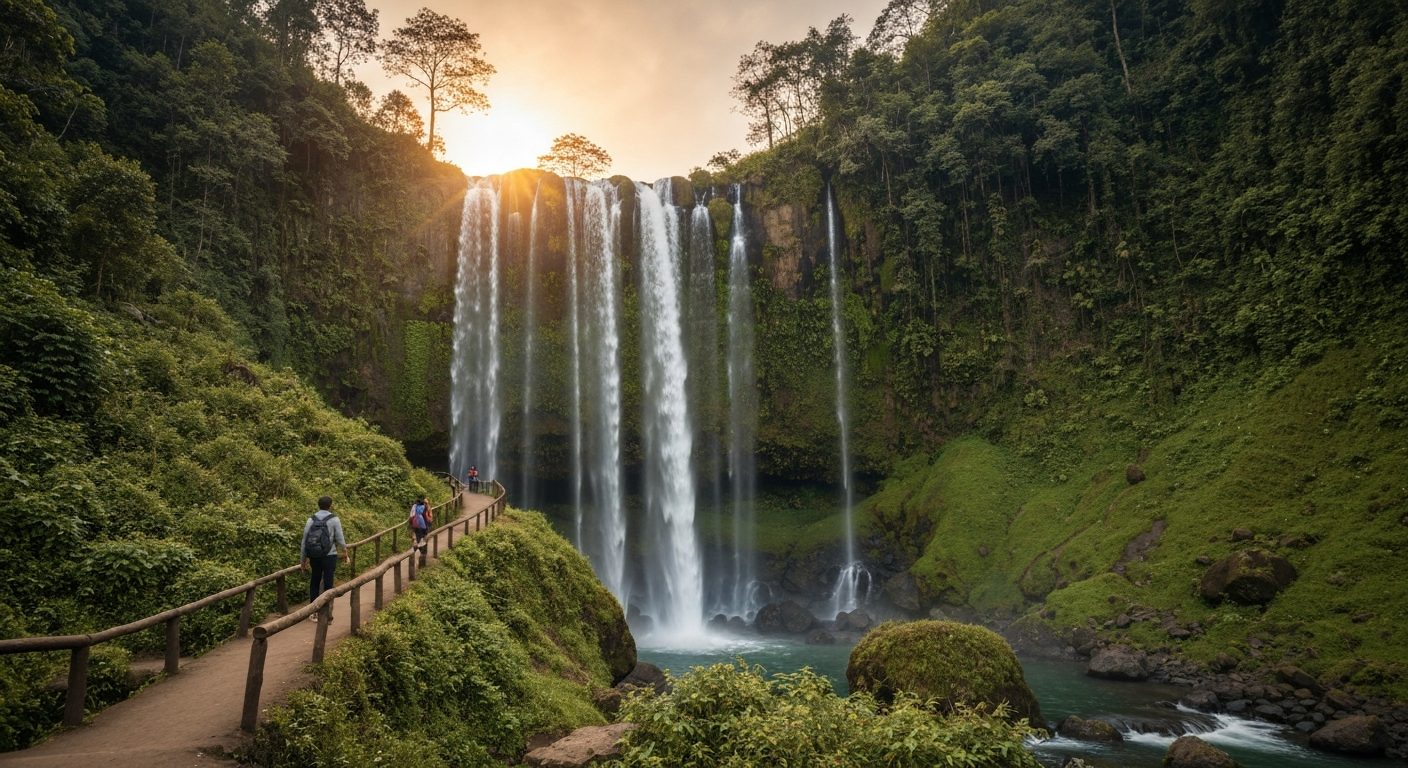
If you’re considering the Tumpak Sewu thousand waterfalls hike, you’re looking at one of East Java’s most visually dramatic natural attractions. This guide breaks down everything you need to know about experiencing Tumpak Sewu, from the different viewpoints to the real tumpak sewu waterfall hike difficulty level, ensuring you’re fully prepared for this remarkable journey. We’ll also cover nearby cascades like Kapas Biru Waterfall Lumajang East Java and how to integrate these into your broader Bali-to-Java travel plans.
Tumpak Sewu, often translated as “a thousand waterfalls,” isn’t just one cascade but a curtain of many, pouring over a vast, horseshoe-shaped cliff face. Located in the Lumajang regency, on the southern slopes of Mount Semeru, Indonesia’s highest volcano in Java, it offers an incredible spectacle for those willing to make the journey. It’s a key destination for travelers extending their Bali trip into East Java, typically paired with sunrise at Mount Bromo and the blue fire trek at Ijen crater.
Unlike many waterfalls you can simply drive up to, Tumpak Sewu presents an adventure with two distinct experiences: a panoramic top viewpoint and a challenging descent to the base. Understanding these differences and the logistical demands is crucial for planning your visit.
What is Tumpak Sewu and Why Visit?
Tumpak Sewu is unique because of its sheer scale and formation. The waterfalls cascade from a height of approximately 120 meters (around 400 feet) into a lush, jungle-clad amphitheater. The water originates from the Glidih River, fed by the powerful currents of Mount Semeru. The sight of countless streams converging and plunging into the valley below is truly awe-inspiring, especially when viewed from the bottom.
Many travelers come here seeking a deeper connection with Indonesia’s natural beauty, beyond Bali’s beaches and rice paddies. It’s an active adventure, a contrast to leisurely sightseeing, requiring physical effort and a readiness for raw nature. The reward is a profound sense of accomplishment and photographic opportunities that are hard to match anywhere else.
The Two Realities: Tumpak Sewu Bottom Viewpoint vs. Top Viewpoint
When planning your visit, it’s essential to understand that Tumpak Sewu offers two very different experiences, each with its own access and challenges. Many online photos might show only the grand scale from the top, or the intimate perspective from the bottom, without fully explaining the journey to each.
The Panoramic Top Viewpoint (Goa Tetes Viewpoint)
This viewpoint is the most accessible. From the main entrance area, a short walk of about 5-10 minutes on a relatively flat, well-maintained path brings you to a sheltered viewing area. From here, you get a wide, sweeping panorama of the entire waterfall curtain. The scale is immense. You’ll see the water pouring down into the dense jungle canyon, with the distant peak of Mount Semeru often visible on a clear day.
- Pros: Easy access, requires minimal physical effort, excellent for wide-angle photography, great for those with limited mobility or time.
- Cons: You’re quite far from the base; you don’t feel the spray or hear the roar up close. It lacks the immersive adventure of the descent.
- Cost: Entrance to the top viewpoint area is typically around IDR 10,000 per person (last verified June 2026).
The Immersive Bottom Viewpoint Descent
This is where the real adventure begins. To reach the base of Tumpak Sewu, you undertake a challenging, approximately 45-60 minute descent through a steep ravine. This path involves navigating slippery rocks, climbing down bamboo ladders, and using ropes for support. Once at the bottom, you’ll walk across rocky riverbeds, sometimes wading through shallow water, to reach the main amphitheater.
- Pros: Incredible, immersive experience. You stand directly in front of the “thousand waterfalls,” feeling their immense power and spray. The scale is overwhelming. This is where you get the iconic photos looking up at the curtain of water.
- Cons: Physically demanding, requires agility, proper footwear, and a good level of fitness. It can be genuinely hazardous, especially after rain. A local guide is required for safety.
- Cost: Entrance for the bottom viewpoint, which includes access to the path and typically the compulsory local guide service, is around IDR 20,000-50,000 per person (last verified June 2026), depending on whether a separate guide fee is charged or included.
Many visitors combine both viewpoints, starting with the panoramic view from the top before committing to the descent. This allows for a full appreciation of Tumpak Sewu’s grandeur.
- Top Viewpoint
- Panoramic, easy access, 5-10 min walk, IDR 10,000 entrance.
- Bottom Viewpoint
- Immersive, challenging descent, 45-60 min hike, ropes/ladders, local guide required, IDR 20,000-50,000 entrance (incl. guide).
Tumpak Sewu Waterfall Hike Difficulty Level: A Realistic Assessment
Let’s be clear: the tumpak sewu waterfall hike difficulty level for the descent to the bottom viewpoint is moderate to challenging. It is not a casual stroll. Anyone attempting this should be prepared for a genuine physical undertaking.
The trail is natural, not paved. You will encounter:
- Steep, often slippery, terrain: Volcanic rock and mud can be treacherous, especially if wet.
- Bamboo ladders: These are simple, sometimes rustic, structures that you’ll need to climb down. They require steady footing and good grip.
- Rope assistance: Sections of the path have ropes fixed to the rock face. You’ll use these for balance and to lower yourself down steep sections. This is why tumpak sewu guide required safety rope climbing is a crucial aspect of the experience.
- River crossings: Depending on water levels, you might need to wade through ankle-deep or even knee-deep water. The current can be strong in places.
- Uneven surfaces: Expect rocks, roots, and slippery moss.
The entire round trip to the bottom and back up can take anywhere from 2 to 4 hours, depending on your fitness level and how much time you spend at the base. It’s physically demanding on the knees and ankles, and requires balance and coordination.
Who is this hike suitable for?
- Individuals with a good level of fitness and no significant mobility issues.
- Those who are comfortable with heights and scrambling.
- Adventurous travelers who are prepared to get wet and muddy.
Who might find this hike challenging or unsuitable?
- Young children (under 8-10 years old, depending on their agility).
- Elderly individuals or those with knee, ankle, or back problems.
- Anyone with a fear of heights or very limited mobility.
Always listen to your local guide’s instructions. They know the terrain and current conditions best.
Your Essential Packing List: What Tumpak Sewu Hiking Boots Shoes Needed?
The right gear makes a huge difference to your safety and enjoyment. Do not underestimate the terrain.
- Proper Footwear (Crucial): This is the most important item. Tumpak Sewu hiking boots shoes needed should be sturdy, closed-toe, with good grip.
- Best: Waterproof hiking shoes or boots with excellent traction. They will protect your feet from sharp rocks and provide stability on slippery surfaces.
- Acceptable (but less ideal): Sturdy sports sandals with ankle straps (like Tevas or Chacos) or water shoes with good sole grip. Be aware that your feet will be exposed to more potential cuts and bruises.
- NOT Recommended: Flip-flops, regular open-back sandals, Crocs, or fashion sneakers with smooth soles. These offer no grip, no ankle support, and will lead to slips and potential injury. Your shoes will get wet and muddy.
- Lightweight, Quick-Drying Clothing: You’ll sweat, and you might get wet from river crossings or waterfall spray. Synthetic fabrics are ideal.
- Swimwear (Optional): If you wish to cool off in some of the shallower pools (always check with your guide about safety).
- Small Backpack: To carry your essentials.
- Waterproof Bag/Dry Bag: Absolutely essential for protecting your phone, camera, and wallet from water and spray. Even if you don’t fall in, the mist at the base of the falls is pervasive.
- Water Bottle: Stay hydrated.
- Snacks: Energy bars or fruit are good for a boost.
- Sunscreen and Hat: While much of the descent is shaded, the top viewpoint and some open sections can be exposed.
- Insect Repellent: Jungle environment means mosquitoes.
- Small First-Aid Kit: Blister plasters, antiseptic wipes, pain relief. Your guide will have a basic kit, but personal items are always useful.
- Camera: A GoPro or a phone with a waterproof case is perfect. For DSLRs, ensure maximum protection.
Leave unnecessary valuables at your accommodation or in the car. Keep your hands free as much as possible for balance and holding onto ropes.
Why a Local Guide is Required for Tumpak Sewu Safety Rope Climbing
For the descent to the base of Tumpak Sewu, a local guide is not just recommended; it is required. This isn’t merely a formality; it’s a critical safety measure.
- Navigational Expertise: The path is not always clearly marked and can change due to weather and erosion. Local guides know the safest routes, where to step, and how to navigate tricky sections.
- Safety Assistance: Guides provide direct physical assistance, pointing out stable handholds and foot placements. They will help you with the tumpak sewu guide required safety rope climbing sections, ensuring you use them correctly. They can help carry bags or offer a steady hand where needed.
- Real-time Conditions: They assess the current conditions – water levels in the river, slipperiness of rocks, potential for flash floods. They can make the call to turn back if conditions become unsafe.
- Local Knowledge: Beyond safety, guides offer insights into the local culture, geology, and ecology of the area. They can enhance your experience significantly.
- Emergency Response: In case of an accident, a local guide is equipped to provide immediate assistance and knows how to summon further help.
At Bali Premium Trip, we arrange vetted, licensed local guides who are experts in the Tumpak Sewu terrain. These guides are your essential companions for a safe and enriching experience. Our booking includes these local guides as part of your comprehensive tour package.
Beyond Tumpak Sewu: Kapas Biru Waterfall Lumajang East Java & Rarajuan
While Tumpak Sewu is the star, the Lumajang region is rich with other incredible waterfalls, especially Kapas Biru Waterfall Lumajang East Java and Rarajuan Waterfall. These can be visited on the same day as Tumpak Sewu, offering a diverse waterfall experience.
Kapas Biru Waterfall: The Blue Cotton Falls
Located approximately 30-45 minutes drive from Tumpak Sewu, Kapas Biru (meaning “blue cotton”) offers a different, yet equally captivating, spectacle. It’s characterized by its powerful, single-plunge cascade, often surrounded by a misty, bluish haze that gives it its name.
- Hike: The hike to Kapas Biru is also a descent, but generally considered slightly less challenging than Tumpak Sewu’s. It involves bamboo ladders and some scrambling, but is often shorter (around 20-30 minutes descent). You’ll typically cross a river via a suspension bridge.
- Experience: At the base, you can get very close to the powerful waterfall, feeling its spray. It’s a great spot for swimming in the cool pools (again, check with your guide).
- Vibe: Less crowded than Tumpak Sewu, offering a more tranquil, intimate experience with a single, majestic column of water.
- Cost: Entrance is usually around IDR 10,000 per person (last verified June 2026). A local guide is highly recommended, though sometimes optional for this one depending on group size and conditions.
Rarajuan Waterfall: The Secluded Beauty
For those seeking an even more off-the-beaten-path adventure, Rarajuan Waterfall tour Bali Java is an excellent addition. It’s less known and therefore even more secluded than Kapas Biru. Reaching Rarajuan often involves a longer trek through local plantations and jungle, and the path can be more rustic.
- Hike: Expect a more natural, less developed trail. It might involve more river crossings and a bit more trekking time.
- Experience: The reward is a series of beautiful, tiered cascades and swimming holes, often with no other tourists around. It’s perfect for those who appreciate solitude and unspoiled nature.
- Logistics: Due to its remoteness, it’s almost always visited with a local guide arranged through a tour service like ours.
Combining Tumpak Sewu with Kapas Biru and potentially Rarajuan provides a full day of waterfall exploration, showcasing the incredible natural diversity of the Mount Semeru Tumpak Sewu Kapas Biru region.
Best Time to Visit Tumpak Sewu Waterfall
The best time to visit Tumpak Sewu waterfall is during East Java’s dry season, which typically runs from May to October.
- Dry Season (May – October):
- Pros: Lower rainfall means safer hiking conditions. The paths are less slippery, river levels are lower (making crossings easier), and the risk of flash floods is significantly reduced. The skies are generally clearer, offering better visibility for photographs.
- Cons: Can be more crowded, especially during peak tourist months (July-August) and Indonesian holidays.
- Wet Season (November – April):
- Pros: Waterfalls are at their most powerful and voluminous due to heavy rains. The surrounding jungle is incredibly lush and green.
- Cons: This is the high-risk period. Paths become extremely slippery and muddy. River levels can rise dramatically, making crossings dangerous or impossible. Flash floods are a real concern. Access to the bottom viewpoint may be restricted or closed entirely for safety reasons. Visibility can be reduced due to cloud cover and rain.
If you must visit during the wet season, always check local conditions immediately before your trip, and be prepared for potential cancellations or modifications to your itinerary for safety. We always prioritize traveler safety and rely on the expert judgment of our local guides for real-time terrain and weather calls.
Integrating Tumpak Sewu into Your Bali-Java Itinerary
Tumpak Sewu is strategically located to fit perfectly into a comprehensive East Java adventure, often as part of a Bromo-Ijen-Bali circuit. The typical routing often looks like this:
- Bali to East Java (Probolinggo/Malang for Bromo): You’ll take the ferry from Gilimanuk (Bali) to Ketapang (Java), a crossing of about 45-60 minutes, operating 24/7 and costing around IDR 10,000-20,000 per person (last verified June 2026). From Ketapang, our private transfers will take you towards the Bromo area (Cemoro Lawang or nearby towns), a drive of approximately 6-7 hours. This is usually done the day before your Bromo sunrise.
- Mount Bromo to Lumajang (Tumpak Sewu): After your pre-dawn Bromo sunrise tour (which typically ends around 9-10 AM), you’ll travel overland to the Lumajang region for Tumpak Sewu. This drive takes roughly 3-4 hours. You can either visit Tumpak Sewu that afternoon (if you start early enough from Bromo) or stay overnight in Lumajang and visit Tumpak Sewu the following morning.
- Lumajang (Tumpak Sewu) to Ijen Crater: From Lumajang, the drive to the Ijen crater area (near Banyuwangi) takes approximately 4-5 hours. This sets you up for the famous Ijen blue fire trek, which typically starts around 1-2 AM.
- Ijen Crater back to Bali: After Ijen, it’s a short drive (around 1 hour) back to the Ketapang ferry terminal, then the ferry back to Bali, and onward to your desired destination in Bali.
This circuit allows for an efficient exploration of East Java’s major icons. Our Bali Premium Trip team specializes in crafting these multi-destination routes, ensuring seamless private transfers, licensed local guides, and comfortable accommodation throughout your journey.
Ready to experience the grandeur of Tumpak Sewu and East Java’s other natural wonders? Our team at Bali Premium Trip can help you map out the perfect itinerary, handling all the logistics from private transfers to vetted local guides and permits. We’re here to help you plan your trip efficiently and transparently.
Planning Your Tumpak Sewu Waterfall Tour East Java
A tumpak sewu waterfall tour east java requires careful planning, especially when combining it with other destinations like Bromo and Ijen. We at Bali Premium Trip focus on providing comprehensive, expertly arranged tours that prioritize your safety and experience.
We arrange every aspect:
- Private, Air-Conditioned Transfers: From your accommodation in Bali, across the ferry, and throughout your East Java journey, ensuring comfort and efficiency.
- Experienced, Licensed Local Guides: For all park entries and specific treks (like Tumpak Sewu, Bromo, Ijen), our guides are knowledgeable, safety-conscious, and enhance your understanding of the local culture and environment.
- Accommodation: Hand-picked, quality hotels or guesthouses that suit your preferences.
- Entrance Fees and Permits: All necessary park entry fees and permits are managed and included in your tour price.
- Transparent Pricing: We provide honest, upfront pricing for our multi-day tours. For example, a 3-day, 2-night East Java Bromo-Tumpak Sewu-Ijen trip, including private transfers, accommodation, and licensed guides, typically ranges from US$400-800 per person (last verified June 2026, based on 2-4 travelers sharing, land package only). This indicative price varies by season, accommodation choice, and group size. You book directly with our Bali Premium Trip reservations team at these transparent, published rates, with no third-party markup.
We understand the specific demands of traveling between Bali and Java. Our expertise, honed since our founding in Kuta in 2015, allows us to arrange reliable services with local partners, ensuring your journey is smooth and enjoyable. We openly disclose that while we arrange licensed local guides, park jeeps, and permits, we do so via our vetted local partners rather than owning park concessions ourselves. This ensures you benefit from the best local expertise and resources.
Frequently Asked Questions About Tumpak Sewu
Is Tumpak Sewu safe to visit?
Visiting Tumpak Sewu can be safe if you follow all safety guidelines and go with a licensed local guide, especially for the descent to the bottom viewpoint. The main risks involve slippery paths, steep sections, and potential flash floods during heavy rain. Always wear appropriate footwear, listen to your guide, and avoid visiting during extremely wet weather.
How long does it take to hike Tumpak Sewu?
The entire experience, including viewing from the top and hiking down to the bottom and back up, typically takes 2 to 4 hours. The descent itself is about 45-60 minutes, and the ascent can take longer, depending on your fitness level and how much time you spend enjoying the base of the waterfalls.
Can I visit Tumpak Sewu and Bromo on the same day?
It is logistically possible but extremely rushed and tiring. Most travelers visit Bromo for sunrise, then travel to the Lumajang area, stay overnight, and visit Tumpak Sewu the following morning. This allows for a more relaxed and safer experience. Our tours are designed to optimize timing and comfort.
Do I need a tour guide for Tumpak Sewu?
Yes, a local guide is required for the descent to the bottom of Tumpak Sewu. This is for your safety due to the challenging terrain, including steep sections, rope assistance, and river crossings. They provide essential guidance, assistance, and real-time knowledge of the conditions.
What is the difference between Tumpak Sewu and Kapas Biru?
Tumpak Sewu is a wide curtain of “a thousand waterfalls” spread across a vast cliff face, offering an immense panoramic view from the top and an immersive experience at the base. Kapas Biru is a single, powerful, columnar waterfall, known for its misty “blue cotton” appearance and often offers a more intimate experience. Both are located in the Lumajang region and can be visited together.
—
Planning your journey to East Java and its incredible waterfalls doesn’t have to be complicated. Our team at Java From Bali, operated by Bali Premium Trip, is here to handle every detail. From crafting custom itineraries to arranging licensed guides and comfortable transfers, we ensure your trip is smooth, safe, and truly memorable. Get in touch with us today via WhatsApp or our contact page to plan your trip to Tumpak Sewu and beyond.