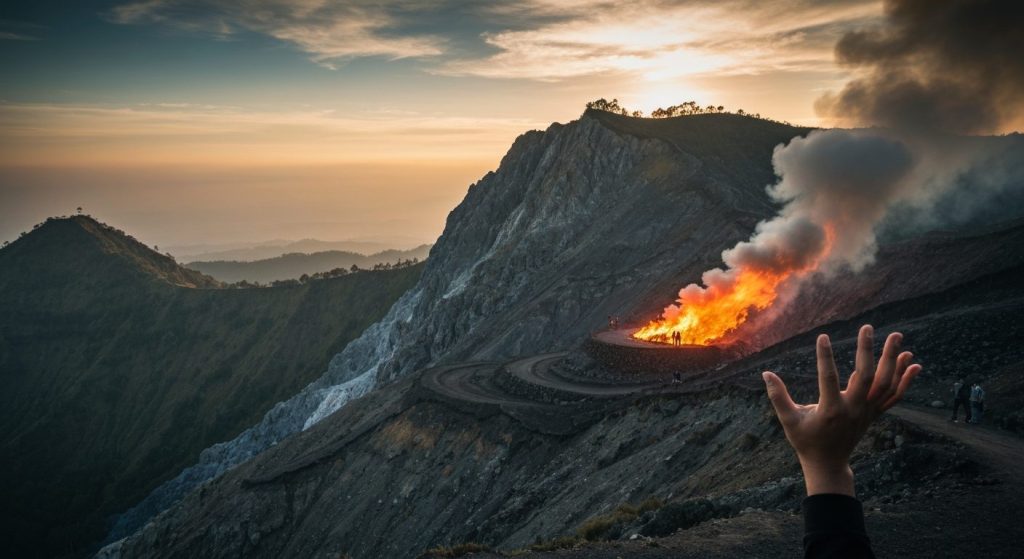
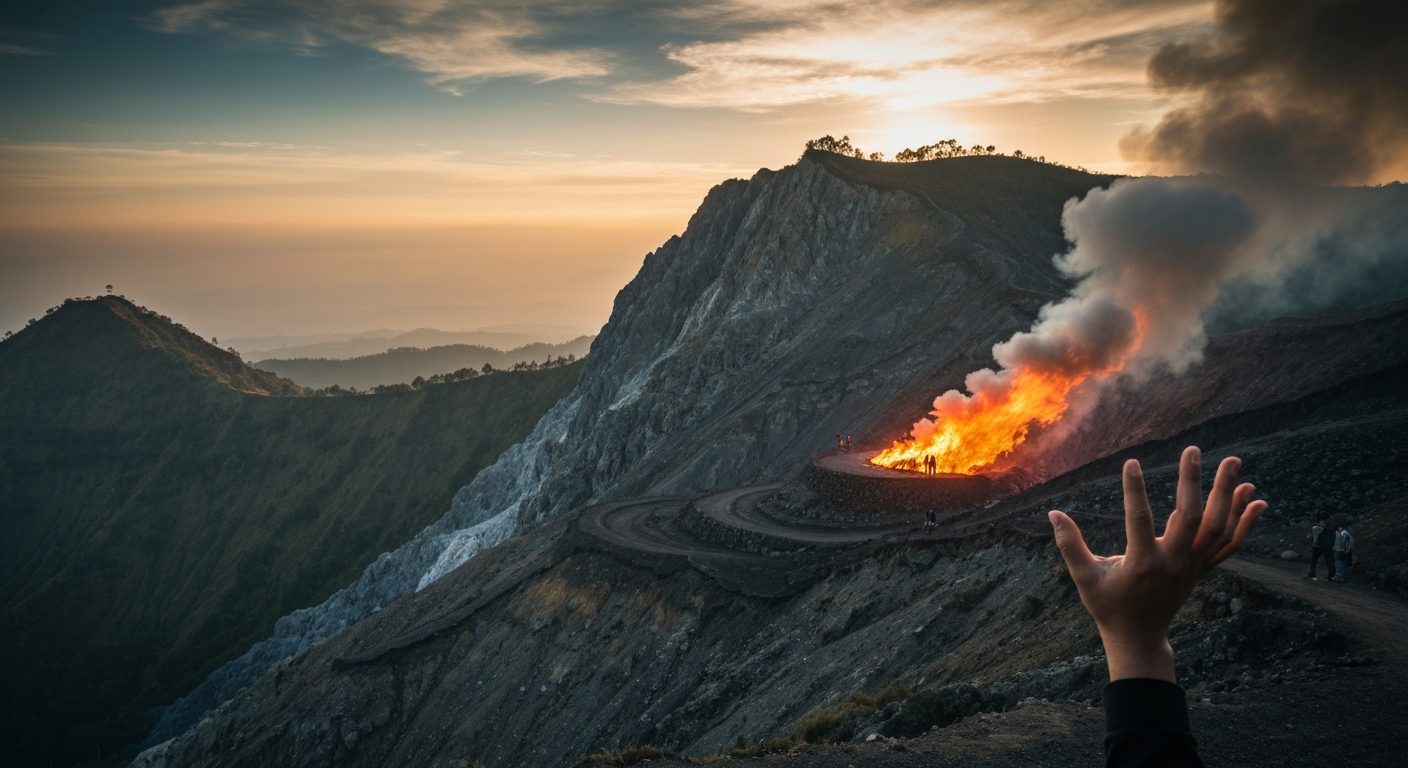
If you’re looking for an Ijen blue fire tour from Bali, you’ve found the definitive guide. This page explains exactly what to expect from a Kawah Ijen blue fire night hike tour, from the realistic logistics of reaching the crater from Bali to the unique experience of witnessing the electric blue flames and the turquoise sulfur lake at sunrise.
Ijen volcano, or Kawah Ijen as it’s known locally, is a sulfur-rich stratovolcano in East Java. Its main draw is the Ijen blue fire, a natural phenomenon created by the combustion of sulfuric gases that emerge from cracks in the volcano at high pressure and temperature. When these gases ignite upon contact with air, they burn with an ethereal blue flame, visible only in complete darkness. This makes a midnight hike essential. Beyond the blue fire, Ijen Crater is also home to the world’s largest acidic crater lake, a striking turquoise body of water that shifts color with the light.
Planning an Ijen crater tour from Bali requires careful consideration of travel time, physical demands, and safety. At Java From Bali, we simplify this process, offering expertly arranged private tours that prioritize your experience, comfort, and safety. We’ve compared dozens of Bali-Java packages to provide you with an honest understanding of what’s involved and how to make the most of your trip.
What is the Ijen Blue Fire Phenomenon?
The Ijen blue fire is not molten lava but rather burning sulfuric gas. This geological marvel occurs when sulfur mining at Ijen Crater releases pure molten sulfur, which flows down the volcano. The gases, under immense pressure, ignite when they come into contact with oxygen in the air, creating flames that can reach up to 5 meters (16 feet) high. The blue color is due to the high concentration of sulfur.
This spectacle is only visible in pitch darkness, making the timing of your visit crucial. The window for seeing the blue fire is typically between 1:00 AM and 5:00 AM, before the first rays of dawn begin to lighten the sky. This is why an Ijen blue fire midnight hike is necessary, starting the ascent from the Paltuding ranger post around 1:00 AM to allow enough time for the hike up, the descent into the crater, and viewing the flames.
The Kawah Ijen Turquoise Lake Sunrise
After witnessing the blue fire, the magic continues as dawn breaks. The Ijen Crater turquoise lake sunrise reveals a landscape unlike any other. The vast, acidic lake, spanning approximately 1 kilometer (0.6 miles) in diameter, glows with an intense turquoise color, framed by the rugged crater walls. This lake is renowned for being the largest highly acidic lake in the world, with a pH of around 0.5. The sulfur deposits around the lake, constantly being mined by local workers, add to the surreal and stark beauty of the environment. The views from the crater rim as the sun rises are truly spectacular, offering a stark contrast to the darkness of the blue fire viewing.
Planning Your Ijen Blue Fire Tour from Bali: Logistics & Routes
A trip from Bali to Ijen involves significant travel, whether you opt for a direct journey or an overnight stop. Understanding the logistics is key to a smooth experience.
The Bali to Ijen Journey: Ferry and Overland
The primary route for an Ijen blue fire tour from Bali involves an overland drive and a ferry crossing.
- Drive to Gilimanuk: From popular South Bali areas like Seminyak or Canggu, the drive to Gilimanuk Port on Bali’s western tip takes approximately 3-4 hours, depending on traffic. This leg typically happens in the late afternoon or early evening to align with the midnight hike.
- Ketapang Ferry Crossing: From Gilimanuk, you’ll board a local ferry to Ketapang Port in Banyuwangi, East Java. The ferry crossing itself is about 1 hour. Ferries operate 24/7, with frequent departures.
- Banyuwangi Basecamp: Once in Ketapang, it’s a short 30-minute drive to Banyuwangi city, which serves as the most convenient base for Ijen.
- Drive to Paltuding Gate: From Banyuwangi, the drive to the Paltuding ranger post (the start point for the Ijen hike) takes approximately 1 to 1.5 hours. This final leg typically occurs around midnight or shortly after, depending on your itinerary.
Considering the travel time, starting directly from South Bali for a midnight hike at Ijen means you would leave Bali late afternoon, arrive in Banyuwangi late evening, and then head straight to the crater. This is a very long day and night, requiring significant stamina.
Overnight Stay in Banyuwangi: Why it’s Recommended
For a more comfortable and less exhausting experience, we highly recommend incorporating an overnight stay in Banyuwangi before your Ijen blue fire midnight hike.
- Rest and Recharge: After the drive and ferry from Bali, arriving in Banyuwangi in the evening allows you to check into a hotel and get a few hours of sleep. This makes the subsequent midnight wake-up and hike much more manageable.
- Reduced Stress: You avoid rushing through the travel segments, reducing the overall stress of the journey.
- Flexibility: An overnight stay provides more flexibility in case of travel delays.
A typical 2-day/1-night Bali to Ijen blue fire package tour would involve:
- Day 1: Pick up from Bali, drive to Gilimanuk, ferry to Ketapang, transfer to Banyuwangi hotel for check-in and rest.
- Day 2: Midnight wake-up, transfer to Paltuding, Ijen hike, return to Banyuwangi for breakfast, then options for onward travel (e.g., flight from Banyuwangi, train to Probolinggo for Bromo, or return to Bali).
We find that most travelers appreciate the opportunity to rest, making the Ijen experience more enjoyable.
The Midnight Start: Paltuding Gate to Crater
The actual Ijen blue fire tour starts from the Paltuding ranger post.
- Arrival at Paltuding: You’ll typically arrive here around 1:00 AM. This is where you’ll sign in, meet your local guide, collect your gas mask, and prepare for the ascent.
- The Hike Up: The trail from Paltuding to the crater rim is approximately 3 kilometers (1.8 miles) long. It’s a moderately challenging uphill hike, with some steep sections. The path is well-worn but unpaved, consisting of loose sand and volcanic rock.
- Crater Descent: Once at the crater rim, if conditions allow and park rangers permit, you’ll begin the descent into the crater. This path is steeper, rockier, and can be slippery, especially in the dark. It’s about a 800-meter (0.5 mile) descent to the blue fire viewing area.
The entire process, from starting the hike to returning to Paltuding, typically takes 4-6 hours, depending on your pace and how long you spend in the crater.
The Kawah Ijen Blue Fire Night Hike Experience
The journey to Ijen is demanding, but the experience itself is deeply rewarding, offering a blend of natural wonder and a glimpse into a unique way of life.
The Ascent: Trail Conditions and Duration
The hike up Mount Ijen from Paltuding is physically demanding, especially in the dark.
- Gradient: The first 1.5 kilometers (0.9 miles) are the steepest, with an average gradient of around 25-30 degrees. The remaining 1.5 kilometers to the rim are less steep but still continuously uphill.
- Surface: The trail is a mix of compacted earth, loose volcanic sand, and small rocks. Sturdy hiking shoes with good grip are essential.
- Duration: Most people take 1.5 to 2 hours to reach the crater rim from Paltuding. The descent into the crater can take an additional 30-45 minutes.
Your local guide will set a comfortable pace, offering assistance and ensuring your safety throughout the climb. Headlamps are crucial for navigating the dark trail.
Crater Descent and Blue Fire Viewing
The descent into the crater is a controlled process and depends entirely on safety conditions and park regulations.
- Safety First: Park authorities may close access to the crater floor if volcanic activity is high or if weather conditions make it unsafe. Your guide will always prioritize your safety and adhere to official directives.
- The Path: The path into the crater is narrow, uneven, and often slippery due to loose rocks and sulfur residue. It’s imperative to follow your guide closely and be cautious with every step.
- Gas Masks: Upon nearing the blue fire, the smell of sulfur becomes very strong. Wearing the provided gas mask is not optional; it’s essential for protecting your respiratory system from the irritating and potentially harmful sulfur dioxide gas.
- The Flames: Witnessing the blue fire up close is a mesmerizing experience. The vibrant blue flames flicker and dance against the dark backdrop, a stark reminder of the raw power of the earth. You’ll typically spend 30-60 minutes here, observing the phenomenon from a safe distance.
It’s important to manage expectations: the blue fire is not a massive, continuous inferno. It’s a localized combustion that varies in intensity and visibility based on gas flow and wind.
Sunrise Over the Turquoise Lake
As the sky begins to lighten, you’ll ascend back to the crater rim. This is where you’ll witness the dramatic reveal of the Kawah Ijen turquoise lake sunrise.
- Color Transformation: The previously dark crater slowly comes to life, first with subtle greys and blues, then bursting into vibrant turquoise as the sun’s first rays hit the lake’s surface. The scale of the crater and the intense color of the lake are truly impressive.
- Panoramic Views: From the rim, you get expansive views of the entire crater, the surrounding volcanic landscape, and often distant peaks emerging from the morning mist. This is a popular spot for photography.
- Miner Activity: Even at sunrise, you’ll see the sulfur miners continuing their arduous work, contrasting with the serene beauty of the lake.
Encountering the Sulfur Miners
The Ijen Crater sulfur mining tour Bali offers a unique and sobering insight into one of the world’s most dangerous professions.
- The Work: Local miners extract blocks of pure sulfur by hand from inside the crater. They then carry these heavy loads – often 70-90 kg (150-200 lbs) – up to the crater rim and down to the weighing station at Paltuding. This is done multiple times a day.
- Conditions: The miners work in extremely harsh conditions, exposed to toxic sulfur fumes, steep and unstable terrain, and heavy physical strain, often for meager wages.
- Respectful Interaction: While it’s natural to be curious, always be respectful. Do not obstruct their path, ask for permission before taking photos, and consider purchasing a small sulfur souvenir directly from them (though be aware of the strong smell and potential for residue). A small tip is also appreciated.
Our guides facilitate respectful interactions and provide context about the miners’ lives, ensuring a meaningful encounter rather than just a tourist spectacle.
Private vs. Group Ijen Crater Tour from Bali: Cost and Value
When planning your Ijen blue fire tour cost from Bali, you generally have two main options: a private tour or a group departure. Both have distinct advantages and price points.
-
Private Ijen Tour
-
- Exclusivity: You travel with your own private vehicle, driver, and dedicated local Ijen guide.
- Flexibility: Complete control over your schedule, pace, and stops. Want to spend more time at sunrise? Need an extra break during the hike? No problem.
- Comfort: Higher-quality vehicles, potentially better hotel options in Banyuwangi, and a more personalized experience.
- Personalized Guidance: Your guide focuses solely on your group, providing more in-depth information and assistance.
- Cost (Indicative, last verified June 2026): For a 2-day/1-night Bali-Ijen private tour, expect to pay approximately US$280 – US$550 per person, based on 2 travelers, varying by season, accommodation level, and specific inclusions. Prices per person generally decrease with more travelers.
-
Group Ijen Tour
-
- Budget-Friendly: Significantly lower cost per person due to shared transport and guide expenses.
- Social Aspect: Opportunity to meet other travelers from around the world.
- Fixed Schedule: Less flexibility; you adhere to a pre-set itinerary and pace.
- Shared Experience: Transport is typically in minivans or small buses, and guides manage a larger group.
- Cost (Indicative, last verified June 2026): For a 2-day/1-night Bali-Ijen group tour, expect to pay approximately US$150 – US$280 per person, varying by operator and inclusions.
At Java From Bali, operated by Bali Premium Trip, we specialize in curated, expert-guided private tours. While we understand the appeal of budget group options, our focus is on delivering a premium experience where the value of personalized service, comfort, and flexibility outweighs the lower upfront cost of a group tour. We find that for a demanding trip like Ijen, the premium for a private tour is truly worth the investment for most travelers. It ensures you have the energy and support to fully appreciate the experience.
When Best to Go: Seasonality and Weather
The best time for an Ijen blue fire midnight hike is during the dry season in Indonesia, which typically runs from May to October.
- Clearer Skies: The dry season offers the highest likelihood of clear skies, which is crucial for both star-gazing during the night hike and for optimal visibility of the blue fire and the sunrise over the turquoise lake.
- Safer Trails: Dry conditions mean less slippery trails, making the ascent and descent significantly safer and more comfortable.
- Reduced Closures: While volcanic activity can cause closures at any time, the dry season generally presents fewer weather-related disruptions.
The rainy season (November to April) brings higher chances of rain, making trails muddy and slippery, potentially obscuring views, and increasing the risk of park closures. While tours still operate, the experience can be less enjoyable and more challenging.
Ijen Blue Fire Midnight Hike: When Best to Go
Within the dry season, any time is generally good, but remember that the blue fire is a natural phenomenon. Its intensity can vary, and its visibility is entirely dependent on darkness and gas emissions. Your guide will provide real-time updates on conditions.
Safety Considerations for Your Ijen Blue Fire Trip
While a Kawah Ijen tour Bali package is an incredible experience, it’s vital to be aware of the inherent risks and prepare accordingly. This is practical information, not medical advice.
- Sulfur Gas Exposure: The most significant hazard is the sulfur dioxide gas. Always wear your provided gas mask when in the crater, especially near the blue fire. If you experience persistent coughing, shortness of breath, or eye irritation, alert your guide immediately. People with respiratory conditions (e.g., asthma) should consult their doctor before undertaking this trip.
- Altitude: The peak of Ijen is approximately 2,799 meters (9,183 feet) above sea level. While not extremely high, some individuals may experience mild altitude sickness symptoms like headache or nausea. Stay hydrated.
- Terrain: The trails are steep, uneven, and can be slippery, especially during the descent into the crater. Wear sturdy hiking boots with good ankle support.
- Darkness: The hike begins in complete darkness. A good headlamp is essential. Stick with your guide and group.
- Volcanic Activity: Ijen is an active volcano. Park authorities (PVMBG – Center for Volcanology and Geological Hazard Mitigation) regularly monitor its status. Access to the crater or the entire mountain may be restricted or closed if activity levels are deemed unsafe. Such closures are for your safety and are non-negotiable. Your guide will communicate any changes.
- Fitness Level: A moderate to good level of physical fitness is required for the hike. If you have any mobility issues or pre-existing health conditions, discuss them with our team when planning your trip.
Our guides are trained to manage these risks, provide assistance, and ensure you have a safe experience. We provide all necessary safety gear, including gas masks and headlamps.
What’s Included (and Not Included) in a Bali Premium Trip Ijen Package
Transparency about what your kawah ijen tour Bali package covers is a core value at Java From Bali.
Typically Included in our Private Ijen Tours:
- Private Air-Conditioned Transport: From your hotel in Bali (e.g., Seminyak, Canggu, Ubud) to Gilimanuk Port, and then private vehicle transfers from Ketapang Port to Banyuwangi, and to/from Paltuding gate.
- Ferry Tickets: Return tickets for the Gilimanuk-Ketapang ferry crossing.
- Accommodation: 1 night in a comfortable hotel in Banyuwangi (e.g., 3-4 star category, with breakfast), if opting for the 2D/1N itinerary.
- Licensed Local Ijen Guide: An experienced, English-speaking local guide specifically for the Ijen hike. Our guides are vetted partners, licensed to operate within the park.
- Entry Permits: Kawah Ijen National Park entrance fees.
- Safety Gear: High-quality gas masks and headlamps for the night hike and crater descent.
- Bottled Water: Provided during transfers and the hike.
- Toll Fees & Parking: All associated road tolls and parking fees.
Typically NOT Included:
- Meals (unless specified): Lunch and dinner are generally not included, allowing you flexibility to choose your own. Breakfast is usually included with accommodation.
- Personal Expenses: Souvenirs, extra snacks, drinks, and personal tips for guides/drivers are not covered.
- Travel Insurance: We strongly recommend purchasing comprehensive travel insurance covering medical emergencies, trip cancellations, and unforeseen circumstances.
- Porter Services: While miners sometimes offer to push or pull you up the mountain for a fee, this is an independent service and not part of our tour package. We do not endorse or arrange this service.
- Visa Fees: If applicable for your nationality.
- Flights: Any flights to or from Banyuwangi (e.g., if continuing to Jakarta or Surabaya) are separate.
We are transparent that Bali Premium Trip plans and operates the tour with its own Bali team and arranges licensed, vetted on-ground Ijen guides, permits, and transfers. We do not own park concessions ourselves. This allows us to partner with the best local experts in each region, ensuring high-quality service and local insight.
Booking Your Ijen Blue Fire Tour from Bali with Java From Bali
Ready to plan your Ijen blue fire adventure? We make the process simple and transparent. As an independent planning guide and concierge service operated by Bali Premium Trip, we map every route, price every itinerary honestly, and arrange private, expert-guided multi-destination tours. You book directly with our own Bali Premium Trip reservations team at transparent, published rates with no third-party markup.
We are Bali Premium Trip, a Bali-based luxury travel concierge founded in Kuta in 2015. Our expertise ensures a seamless and enriching journey for you.
To start planning your perfect Java From Bali trip, including your visit to Mount Ijen from Bali, reach out to our team. We’re here to answer your questions and customize an itinerary that fits your interests and schedule.
Plan Your Trip today, or connect with us directly via WhatsApp at +6281128590000 or email [email protected].
Frequently Asked Questions About the Ijen Blue Fire Tour
Is the Ijen blue fire visible every night?
The Ijen blue fire is a natural phenomenon caused by burning sulfur gases, and its visibility depends on complete darkness and the level of gas emissions. It is typically visible between 1:00 AM and 5:00 AM. However, natural factors like strong winds or heavy rain can temporarily affect its visibility. Park authorities may also close crater access if volcanic activity is too high.
What should I bring for the Ijen blue fire night hike?
You should bring warm layers of clothing (it can be cold at the crater rim), sturdy hiking shoes with good grip, a small backpack for essentials, personal snacks, a reusable water bottle, sunglasses, a hat, and a camera. We provide gas masks and headlamps.
How difficult is the hike to Kawah Ijen?
The hike to Kawah Ijen is moderately challenging. The trail from Paltuding to the crater rim is about 3 kilometers (1.8 miles) uphill, with some steep sections, taking 1.5-2 hours. The descent into the crater (if permitted) is shorter but steeper and rockier. A reasonable level of fitness is required.
Can children join the Ijen blue fire tour?
While there is no strict age limit, the Ijen blue fire tour involves a strenuous midnight hike in challenging conditions, exposure to sulfur gas, and an active volcanic environment. It is generally not recommended for very young children, pregnant women, or individuals with pre-existing respiratory or heart conditions. We suggest children be at least 12-14 years old and physically fit.
What happens if the Ijen crater is closed due to volcanic activity?
Safety is our top priority. If Kawah Ijen Crater is closed by PVMBG (the Center for Volcanology and Geological Hazard Mitigation) due to heightened volcanic activity or unsafe conditions, your guide will inform you immediately. In such cases, we would explore alternative activities in the Banyuwangi area or adjust your itinerary, and discuss refund or rescheduling options for the Ijen portion of the trip.